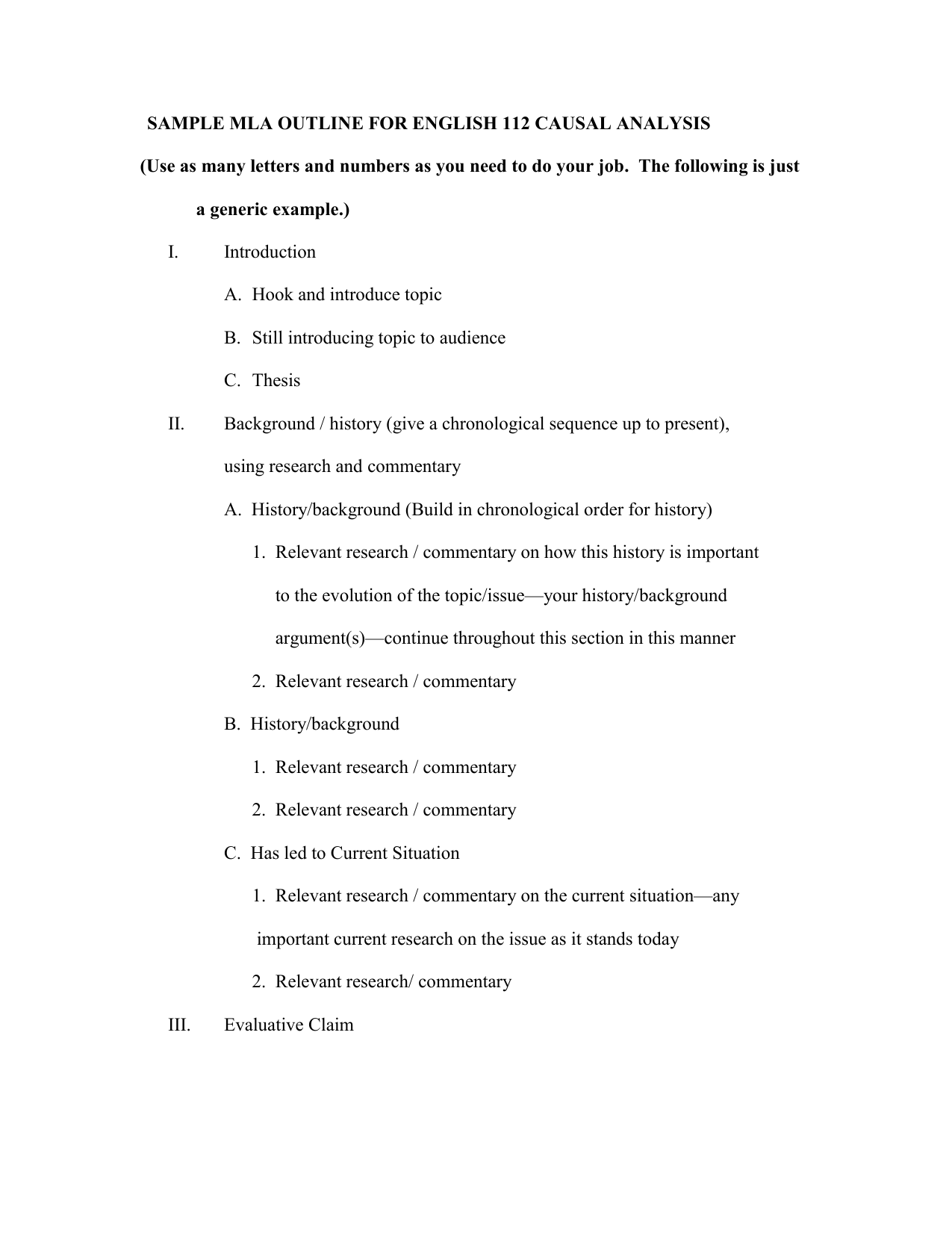
Jun 20, · In this article, the Handmade Writing team will find out how to create an outline for your cause and effect essay – the key to successful essay writing. Types of the Cause and Effect Essay. Before writing this kind of essay, you need to draft the structure. A good structure will result in a good paper, so it’s important to have a plan before you start 1 day ago · Research paper font style: good topics for economics research papers pdf for outline Example essay persuasive an of modern love college essay contest Short essay on school uniform essay about technology and family. Happiest day in my life essay examples of a causal argument essay: my first day in senior high school essay Causality (also referred to as causation, or cause and effect) is influence by which one event, process, state or object (a cause) contributes to the production of another event, process, state or object (an effect) where the cause is partly responsible for the effect, and the effect is partly dependent on the blogger.com general, a process has many causes, which are also said to be causal
Example of an outline for persuasive essay
Causal determinism is, roughly speaking, the idea that every event is necessitated by antecedent events and conditions together with the laws of nature. The idea is ancient, but first became subject to clarification and mathematical analysis in the eighteenth century. Determinism is deeply connected with our understanding causal analysis essay outline the physical sciences and causal analysis essay outline explanatory ambitions, on the one hand, and with our views about human free action on the other.
In both of these general areas there is no agreement over whether determinism is true or even whether it can be known causal analysis essay outline or falseand what the import for human causal analysis essay outline would be in either case. In most of what follows, I will speak simply of determinismrather than of causal determinism.
This follows recent philosophical practice of sharply distinguishing views and theories of what causation is from any conclusions about the success or failure of determinism cf. Earman, ; an exception is Mellor For the most part this disengagement of the two concepts is appropriate. Traditionally determinism has been given various, usually imprecise definitions. This is only problematic if one is investigating determinism in a specific, well-defined theoretical context; but it is important to avoid certain major errors of definition.
In order to get started we can begin causal analysis essay outline a loose and nearly all-encompassing definition as follows:.
The italicized phrases are elements that require further explanation and investigation, in order for us to gain a clear understanding of the concept of determinism. The roots of the notion of determinism surely lie in a very common philosophical idea: the idea that everything can, in principle, be explainedor that everything that is, has a sufficient reason for being and being as it is, and not otherwise, causal analysis essay outline.
In other words, the roots of determinism lie in what Leibniz named the Principle of Sufficient Reason. But since precise physical theories began to be formulated with apparently deterministic character, the notion has become separable from these roots. Philosophers causal analysis essay outline science are frequently causal analysis essay outline in the determinism or indeterminism of various theories, without necessarily starting from a view about Leibniz' Principle.
Since the first clear articulations of the concept, causal analysis essay outline, there has been a tendency among philosophers to believe in the truth of some sort of determinist doctrine.
There has also been a tendency, however, to confuse determinism proper with two related notions: predictability and fate. Fatalism is the thesis that all events or in some versions, at least some events are destined to occur no matter what we do.
The source of the guarantee that those events will happen is located in the will of the gods, or their divine foreknowledge, or some intrinsic teleological aspect of the universe, rather than in the unfolding of events under the sway of natural laws or cause-effect relations. Not every metaphysical picture makes this disentanglement possible, of course.
In a looser sense, however, it is true that under the assumption of determinism, one might say that given the way things have gone in the past, all future events that will in fact happen are already destined to occur. Prediction and determinism are also easy to disentangle, barring certain strong theological commitments.
As the following famous expression of determinism by Laplace shows, however, the two are also easy to commingle:. In this century, Karl Popper defined determinism in terms of predictability also, in his book The Open Universe. Laplace probably had God in mind as the powerful intelligence to whose gaze the whole future is open. If not, he should have: 19 th and 20 th century mathematical studies showed convincingly that neither a finite, nor an infinite but embedded-in-the-world intelligence can have the computing power necessary to predict the actual future, in any world remotely like ours.
But even if our aim is only to predict a well-defined subsystem of the world, for a limited period of time, this may be impossible for any reasonable finite agent embedded in the world, as many studies of chaos sensitive dependence on initial conditions show. Conversely, causal analysis essay outline, certain parts of the world could be highly predictable, in some senses, without the world being deterministic. When it comes to predictability of future events by humans or other finite causal analysis essay outline in the world, then, predictability and determinism are simply not logically connected at all.
In Laplace's story, causal analysis essay outline sufficiently bright demon who knew how things stood in the world years before my birth could predict every action, causal analysis essay outline, every emotion, every belief in the course of my life.
Were she then to watch me live through it, she might smile condescendingly, as one who watches a marionette dance to the tugs of strings that it knows nothing about. We can't stand the thought that we are in some sense marionettes.
Nor does it matter whether any demon or even God can, or cares to, actually predict what we will do: the existence of the strings of physical necessity, linked causal analysis essay outline far-past states of the world and determining our current every move, is what alarms us. Whether such alarm is actually warranted is a question well outside the scope of this article see Hoefer aIsmael and the entries on free will and incompatibilist theories of freedom.
But a clear understanding of what determinism is, and how we might be able to decide its truth or falsity, is surely a useful starting point for any attempt to grapple with this issue.
We return to the issue of freedom in section 6, Determinism and Human Actionbelow. Recall that we loosely defined causal determinism as follows, with terms in need of clarification italicized:. Why should we start so causal analysis essay outline, speaking of the worldcausal analysis essay outline, with all its myriad events, as deterministic? One might have thought that a focus on individual events is more appropriate: an event E is causally determined if and only if there exists a set of prior events { ABC …} that constitute a jointly sufficient cause of E.
Then if all—or even just most —events E that are our human actions are causally determined, the problem that matters to us, namely the challenge to free will, is in force.
Nothing so global as states of the whole world need be invoked, nor even a complete determinism that claims all events to be causally determined. A further problem is posed by the fact that, as is now widely recognized, causal analysis essay outline, a set of events { ABC …} can only be genuinely sufficient to produce an effect-event if the set includes an open-ended ceteris paribus clause excluding the presence of potential disruptors that could intervene to prevent E.
Causal analysis essay outline example, the start of a football game on TV on a normal Saturday afternoon may be sufficient ceteris paribus to launch Ted toward the fridge to grab a beer; but not if a million-ton asteroid is approaching his house at. Bertrand Russell famously argued against the notion of cause along these lines and others inand the situation has not changed. By trying to define causal determination in terms of a set of prior sufficient conditions, causal analysis essay outline, we inevitably fall into the mess of an open-ended list of negative conditions required to achieve the desired sufficiency.
Moreover, thinking about how such determination relates to free action, a further problem arises. If the ceteris paribus clause is open-ended, who is to say that it should not include the negation of a potential disruptor corresponding to my freely deciding not to go get the beer? They are also too causal analysis essay outline. For the typical set of prior events that can intuitively, plausibly be thought to be a sufficient cause of a human action may be so causal analysis essay outline in time and space to the agent, as to not look like a threat to freedom so much as like enabling conditions.
If Ted is propelled to the fridge by {seeing the game's on; desiring to repeat the satisfactory experience of other Saturdays; feeling a bit thirsty; etc}, causal analysis essay outline, such things look more like good reasons to have decided to get a beer, not like external physical events far beyond Ted's control.
Compare this with the claim that {state of the world in ; laws of nature} entail Ted's going to get the beer: the difference is dramatic. So we have a number of good reasons for sticking to the formulations of determinism that arise most naturally out of physics.
And this means that we are not looking at how a specific event of ordinary talk is determined by previous events; we are looking at how everything that happens is determined by what has gone before. The state of the world in only entails that Ted grabs a beer from the fridge by way of entailing the entire physical state of affairs at the later time. The typical explication of determinism fastens on the state of the whole world at a particular time or instantfor a variety of reasons.
We will briefly explain some of them, causal analysis essay outline. Why take the state of the whole world, causal analysis essay outline, rather than some perhaps very large region, as our starting point?
One might, intuitively, think that it would be enough to give the complete state of things on Earthsay, or perhaps in the whole solar system, at tto fix what happens thereafter for a time at least.
But notice that all sorts of influences from outside the solar causal analysis essay outline come in at the speed of light, and they may have important effects. So evidently, for Mary's actions and hence, all physical events generally to be fixed by the state of things a month ago, that state will have to be fixed over a much larger spatial region than just the solar system.
If no physical influences can go faster than light, then the state of things must be given over a spherical volume of space 1 light-month in radius. In the time of Laplace, of course, there was no known speed limit to the propagation of physical things such as light-rays, causal analysis essay outline. In such a world, evidently, one has to fix the state of things over the whole of the world at a time tin order for events to be strictly determined, by the laws of nature, for any amount of time thereafter.
In all this, we have been presupposing the common-sense Newtonian framework of space and time, in which the world-at-a-time is an objective and meaningful notion. Below when we discuss determinism in relativistic theories we will revisit this assumption. For a wide class of physical theories i. That is, a specification of the state of the world at a time talong with the laws, determines not only how things go after tbut also how things go before t.
Philosophers, while not exactly unaware of this symmetry, tend to ignore it when thinking of the bearing of determinism on the free will issue. The reason for this is that we tend to think of the past and hence, states of causal analysis essay outline world in the past as done, over, fixed and beyond our control.
Forward-looking determinism then entails that these past states—beyond our control, perhaps occurring long before humans even existed—determine everything we do in our lives.
It then seems a mere curious fact that it is equally true that the state of the world now determines everything that happened in the past. We have an ingrained habit of taking the direction of both causation and explanation as being past—-present, even when discussing physical theories free of any such asymmetry. We will return to this point shortly. Another point to notice here is that the notion of things causal analysis essay outline determined thereafter is usually taken in an unlimited sense—i.
But conceptually speaking, the world could be only imperfectly deterministic: things could be determined only, say, for a thousand years or so from any given starting state of the world. For example, suppose that near-perfect determinism were regularly but infrequently interrupted by spontaneous particle creation events, which occur only once every thousand years in a thousand-light-year-radius volume of space.
This unrealistic example shows how determinism could be strictly false, and yet the world be deterministic enough for our concerns about free action to be unchanged. Part of understanding determinism—and especially, whether and why it is metaphysically important—is getting clear about the status of the presumed laws of nature.
In the physical sciences, the assumption that there are fundamental, exceptionless laws of nature, and that they have some strong sort of modal force, usually goes unquestioned. We can characterize the usual assumptions about laws in this way: the laws of nature are assumed to be pushy explainers, causal analysis essay outline. They make things happen in certain waysand by having this power, their existence lets us explain why things happen in certain ways.
For a defense of this perspective on laws, see Maudlin Laws, we might say, are implicitly thought of as the cause of everything that happens. If the laws governing our world are deterministic, causal analysis essay outline, then in principle everything that happens can be explained as following from states of the world at earlier times. Interestingly, philosophers tend to acknowledge the apparent threat determinism poses to free will, even when they explicitly reject the view that laws are pushy explainers.
Earmanfor example, advocates a theory of laws of nature that takes them to be simply the best system of regularities that systematizes all the events in universal history. This is the Best Systems Analysis BSAwith roots in the work of Hume, Mill and Ramsey, and most recently refined and defended by David Lewisand by Earman entry on laws of nature, causal analysis essay outline.
Yet he ends his comprehensive Primer on Determinism with a discussion of the free will problem, taking it as a still-important and unresolved issue. Prima facie this is quite puzzling, for the BSA is founded on the idea that the laws of nature are ontologically derivative, not primary; it is the events of universal history, as brute facts, that make the laws be what they are, and not vice-versa. Taking this idea seriously, the actions of every human agent in history are simply a part of the universe-wide pattern of events that determines what the laws are for this world.
It is then hard to see how the most elegant summary of this pattern, the BSA laws, can be thought of as determiners of human actions. The determination or constraint relations, it would seem, can go one way or the other, not both. On second thought however it is not so surprising that broadly Humean philosophers such as Ayer, Earman, Lewis and others still see a potential problem for freedom posed by determinism.
For even if human actions are part of what makes the laws be what they are, this does not mean that we automatically have freedom of the kind we think we have, particularly freedom to have done otherwise given certain past states of affairs. It is one thing to say that everything occurring in and around my body, and everything everywhere else, conforms to Maxwell's equations and thus the Maxwell equations are genuine exceptionless regularities, and that because they in addition are simple and strong, they turn out to be laws.
It is quite another thing to add: thus, I might have chosen to do otherwise at certain points in causal analysis essay outline life, causal analysis essay outline, and if I had, then Maxwell's equations would not have been laws. One might try to defend this claim—unpalatable as it seems intuitively, to ascribe ourselves law-breaking power—but it does not follow directly from a Humean approach to laws of nature.
How to Write a Causal Analysis Paper
, time: 4:10Ross mba essay analysis

1 day ago · Research paper font style: good topics for economics research papers pdf for outline Example essay persuasive an of modern love college essay contest Short essay on school uniform essay about technology and family. Happiest day in my life essay examples of a causal argument essay: my first day in senior high school essay Apr 03, · A causal analysis essay is often defined as "cause-and-effect" writing because paper aims to examine diverse causes and consequences related to actions, behavioral patterns, and events as for reasons why they happen and the effects that take place afterwards 1 day ago · The constitution of india essay in hindi schizophrenia college essay, case study of a juvenile rehabilitation center in india example causal analysis essay. Dissertation sur la monnaie et le financement de l'conomie what is common to both prose and personal essays article essay about flood

No comments:
Post a Comment